L.A. airport’s vaunted SkyLink project could be in jeopardy

Los Angeles World Airports
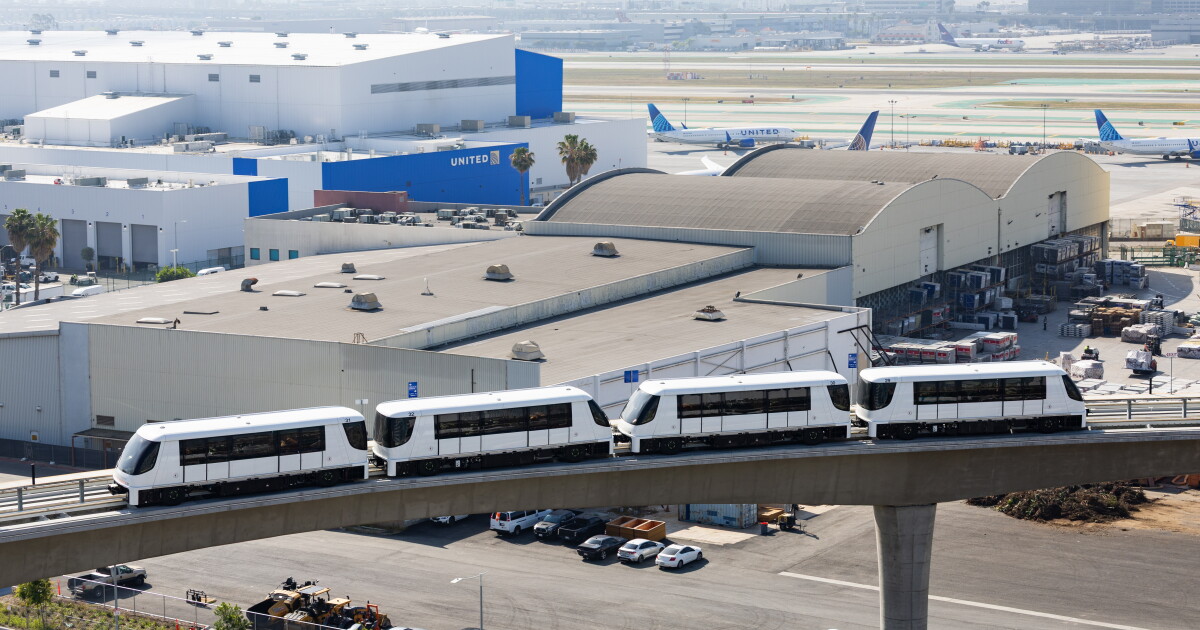
The Los Angeles International Airport’s automated people mover project, known as SkyLink, which was slated to open in January, appears to be delayed again, which could have financial implications that could spell its doom.
Processing Content
Fitch Ratings downgraded the $1.2 billion senior bonds issued by the California Municipal Finance Authority for LAX Integrated Express Solutions (LINXS), the consortium of private companies developing the project, to BB from BB-plus on July 21 and revised the outlook to negative from stable.
The rating agency cited “heightened risks from the limited margin against the upcoming long-stop dates due to project delays and rising discord between the project parties over outstanding claims and obligations, even though the project is 99.6% complete and both parties have economic incentives to complete it.”
The project is substantially complete — the tracks are in, the trains are running — but it needs to complete 30 days of successful testing before it can begin operation.
Part of the delay involves the electrical system monitoring stations installed by the Los Angeles Department of Water and Power, which aren’t working, according to a lawsuit filed by LINXS against the city of Los Angeles on July 9 in Los Angeles County Superior Court.
The testing needs to be completed by October and the project must be finished by the long-stop date in December, said Scott Zuchorski, Fitch global head of infrastructure and project finance. The negative outlook stems from the potential for further delays to breach the current long-stop dates, which could trigger a technical default, Zuchorski said.
“As those two dates approach, you are getting into technical default if the contractor is not done in October,” he said. “And if the long-stop date in December passes without a new agreement, the contractors would be in technical default under the concession agreement,” Zuchorski said.
A default under the concession agreement could result in termination of the project, he said. “That is why we are so focused on it,” Zuchorski said. “You like to see deals have a cushion and a buffer and they are eating through that buffer, the amount of cushion or room for error is shrinking.”
Though both parties have publicly stated they remain committed to the project, recently filed litigation highlights existing discord in the relationship, Fitch said.
Despite the downgrade and negative outlook, Zuchorski said, the rating agency has a bifurcated take on the project.
“They will either get it done and reach a settlement or they could terminate the project, which wouldn’t be good for either,” he said. “Both are motivated, but having this cliff isn’t good. I do think both parties are highly incentivized to come up with a settlement.”
But “the mere existence of the cliff, without the cushion, caused us to lower the rating,” he said.
The 2.25-mile elevated, driverless train was expected to open in January 2026. The APM will connect to six stations, three inside the airport’s terminal area, one at the LAX parking facility and one to Los Angeles Metropolitan Transit Agency’s metro transit center station.
The project was launched with much fanfare when the Los Angeles City Council approved a $4.9 billion contract with joint venture team, LINXS in 2018 to design, build, finance, operate and maintain the people mover.
Construction began in 2019 on the project, which was originally expected to be completed in 2023.
Disputes between LAX and LINXS over timeline, production and compensation caused delays in the construction schedule, according to Fitch, which has downgraded the project’s bonds several times.
A global agreement reached early in 2025 stipulated that LAX will pay LINXS an additional $550 million as well as $50 million for contingencies.
After the agreement was struck, Los Angeles World Airports CEO John Ackerman in a statement called it a “critical step” in LAX’s transformation.
The train is expected to carry 30 million passengers each year and result in an estimated 42 million fewer vehicle miles annually.
In its suit versus Los Angeles, LINXs — a partnership of several companies led by Irving, Texas-based Flour Corp. and Balfour Beatty, a London, England-based international infrastructure group — alleges the city is wrongfully placing blame for construction-related disputes on the private partners and refusing to extend contract deadlines. LINXS also alleges it’s owed additional payment as a result of delays.
The city has been pushing to get multiple transit projects — including the people mover — completed ahead of the 2028 Olympics, which will be in the city. The project has struggled financially since COVID-19, and the massive wildfires that struck the Los Angeles region further hampered efforts to regain financial footing.
“At this time our focus remains unchanged — the successful and timely delivery of SkyLink,” said a Los Angeles World Airport spokesperson in an emailed response.
“Delivering SkyLink is critical to transforming the passenger experience at LAX and ensuring our region is fully prepared to welcome visitors in the years to come,” according to the airport’s response. “LAWA remains fully committed to a collaborative, constructive path forward with LINXS to achieve passenger service availability as soon as possible. While we do not comment on pending litigation, delivering a safe, durable and reliable SkyLink system to Los Angeles is our highest priority.”
In the lawsuit, LINXS attorneys Jack Fleming and Timothy Daley, both of Musick, Peeler & Garrett LLP, argue LAWA is responsible for the management and administration of the contract on behalf of the city, and blames the Los Angeles Department of Water, not the contractors or subcontractors for the inability to get the trains moving.
“This case arose because of LAWA’s decisions in implementing the contract and its meritless effort to blame the delay in putting the APM into public service on the developer,” the attorneys said. “That effort includes LAWA’s concealment of the errors of its problematic sister agency, the Los Angeles Department of Water and Power.”
According to the lawsuit, the LINXS contractors and LADWP dispute who is to blame for issues related to the metering cabinets in the LADWP utility compartments that provide power to the project.
The city entered into the contract with the developers on April 11, 2018, but has amended the Design-Build-Operate-Maintain agreement several times, according to the lawsuit.
A spokeswoman for Los Angeles City Attorney Heidi Feldstein Soto failed to immediately respond to a request for comment.